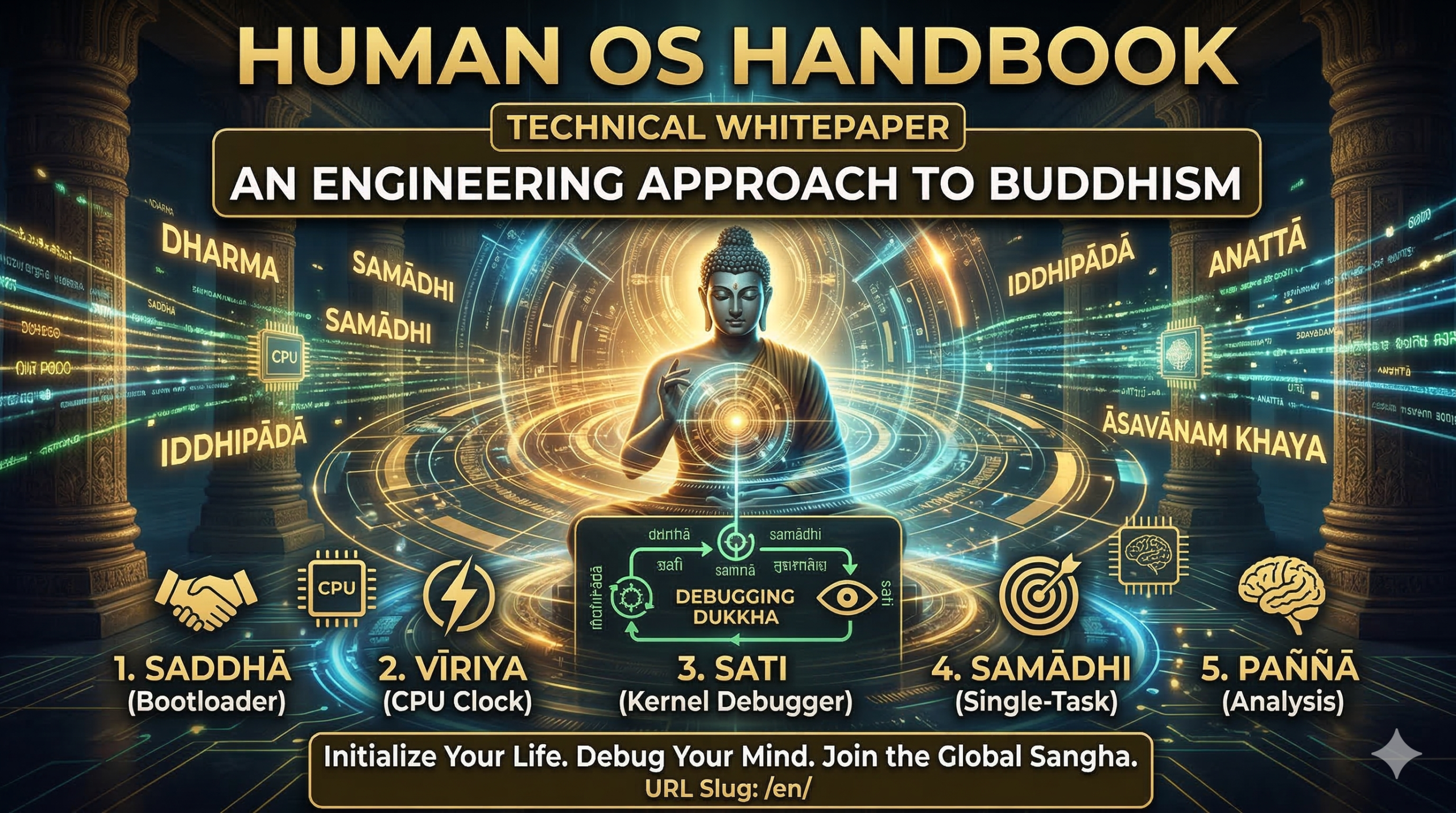
Abstract: Debugging the Human Experience
Human suffering is not a moral failing; it is a system error.
The Human OS Handbook is a technical project that re-interprets 2,500-year-old Buddhist insights through the lens of modern systems engineering. This whitepaper defines the architecture and deployment protocols for upgrading the human consciousness to a stable, “clutter-free” version.
1. Core Architecture: The 5-Faculty Engine
To ensure system stability (Nirvana/Total Debug), we must calibrate five core modules (Indriya):
- Saddhā (Confidence): The bootloader. Validating the “Dharma OS” as a functional hypothesis.
- Vīriya (Energy): CPU power management. Deleting “Akusala” (malware) and installing “Kusala” (stable patches).
- Sati (Mindfulness): The real-time system monitor. Maintaining logs of every sensory I/O.
- Samādhi (Stability): Single-tasking mode. Focusing the RAM on “Vossagga” (Letting Go).
- Paññā (Insight): The data analysis engine. Observing the birth and death (Udaya-Attha) of every process.
2. Strategic Roadmap (Phase 1–3)
- Phase 1: Basic Optimization
Shutting down high-load background processes known as the “5 Hindrances” (Nīvaraṇa). - Phase 2: Kernel Analysis
Deconstructing the “Self” from a permanent administrator to a temporary event-driven process (Anattā). - Phase 3: Network Deployment (SANGHA)
Synchronizing stable nodes via the Mettā P2P Protocol to stabilize the collective environment.
3. Join the Global Sangha
Our main documentation is written in Japanese, but the logic is universal. We invite engineers and researchers worldwide to explore our Kernel Specs using browser translation tools.
Initialize your life. Debug your mind. Join the Sangha.
[Go to Core Specs(Japanese Home)]